
Online learning is no longer a “nice to have” for your career.
It is one of the fastest growing parts of the education world and a key way professionals keep their skills fresh.

Research on the global e learning market shows it was worth almost 300 billion dollars in 2024 and is projected to nearly triple by 2030, driven by corporate training and upskilling.
At the same time, platforms like MasterClass, Coursera, and LinkedIn Learning give you very different paths to grow.

This guide will help you decide whether MasterClass is really the best in professional training for you or if a more traditional platform is a better fit. You will see how MasterClass compares with two big names in career learning, Coursera and LinkedIn Learning, and how to build a smart learning plan around your goalWhy professional training looks different today
Professional training used to mean a classroom, a thick binder, and maybe a boring slideshow. Now most people expect at least part of their learning to happen online.
Global research shows that e learning is growing very fast, with platforms serving both universities and employers who need constant upskilling.
Online professional training has a few key advantages:
- You can learn at your own pace, from home or between meetings.
- You are not limited to local schools or trainers.
- You can focus only on the skills that matter for your next role or promotion.
The result is a crowded market of platforms. To choose well, you need to know what each one is designed to do.
What MasterClass really is in the world of professional training
MasterClass is an online learning platform where you learn from very high profile instructors such as famous chefs, authors, athletes, filmmakers, and business leaders. Its own site describes the offer as online classes “created for students of all skill levels” with “the best in the world” as teachers and thousands of bite sized lessons.

Instead of traditional lectures or slide decks, classes feel like documentary style lessons. You watch how experts think, make decisions, and solve problems.
MasterClass organizes content by goals like:
- Develop my career or leadership skills
- Become a better writer or storyteller
- Improve creativity, design, or communication
From a professional training point of view, that means MasterClass is strongest in:
-
Soft skills and mindset
Leadership, communication, storytelling, negotiation, creativity, and critical thinking. -
Creative and cultural skills
Writing, filmmaking, music, design, and cooking that can support creative careers or side businesses. -
Inspiration and big picture thinking
You see how top performers think, not just what they do.
When you subscribe, you typically pay a single annual fee that unlocks all classes, across all categories, instead of paying per course.
MasterClass is best viewed as a premium, inspiration driven learning library. It is not a classic corporate training platform with tests, long problem sets, or official credentials.
MasterClass vs Coursera vs LinkedIn Learning
To see if MasterClass is the best in professional training for your career, it helps to compare it with two more traditional platforms: Coursera and LinkedIn Learning.
At a glance: side by side comparison
| Platform | Main focus | Library size / content | Credentials | Typical pricing style | Best for |
|---|---|---|---|---|---|
| MasterClass | Inspiration, soft skills, creative and business insights from elite experts | Hundreds of classes and thousands of short lessons | No formal academic credit, some completion tracking | Annual subscription for all classes, billed yearly | Professionals who learn best through stories, role models, and big ideas |
| Coursera | Academic level courses, career certificates, degrees | 10,600 plus courses for business teams and thousands more for individuals | Professional Certificates and sometimes university credit | Individual courses, subscription (Coursera Plus), and full programs | People who want job ready skills and credentials from top universities |
| LinkedIn Learning | Business, tech, and creative skills aligned with jobs | Over 24,000 curated courses and certifications | Certificates that can appear on your LinkedIn profile | Monthly or annual subscription with unlimited library access | Employees and managers who want ongoing upskilling tied to their LinkedIn network |
This table shows the key tradeoff. MasterClass gives you elite mentors and very polished storytelling, while Coursera and LinkedIn Learning lean toward structured, credential oriented professional training.
MasterClass vs Coursera: inspiration vs credentials
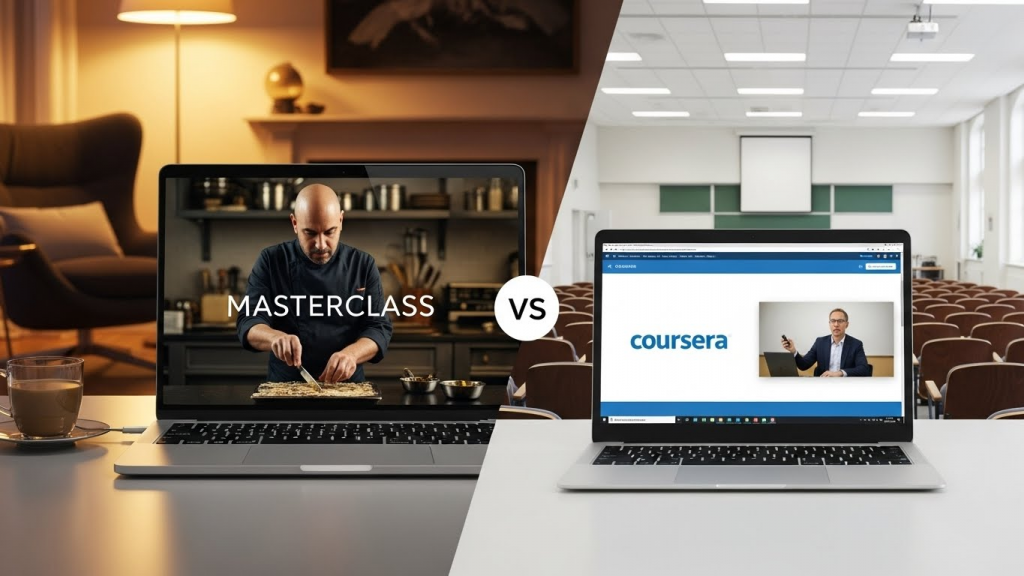
Coursera is built for deeper, career oriented training. You can take full online courses from universities and companies, and you can earn Professional Certificates that help you get job ready in under a year.
Coursera highlights:
- Courses and programs from more than 350 universities and companies around the world.
- Professional Certificates that include hands on projects and sometimes pathways to industry exams.
- Subscriptions such as Coursera Plus that give unlimited access to most courses for a fixed monthly or yearly price.
In contrast, MasterClass:
- Does not offer university credit or diplomas.
- Does not usually include graded assignments or long exams.
- Shines when you want mindset, creativity, and strategic thinking from people at the top of their field.
If your main goal is a promotion, career change, or visa requiring recognized education, a Coursera Professional Certificate or degree is likely stronger. If your goal is to think like a high level creator or leader in your industry, MasterClass can be the spark that shifts your mindset.
For internal linking later, a natural anchor here would be something like online course platforms for career growth, which could point to a broader comparison on your site.
MasterClass vs LinkedIn Learning: stories vs skills at work
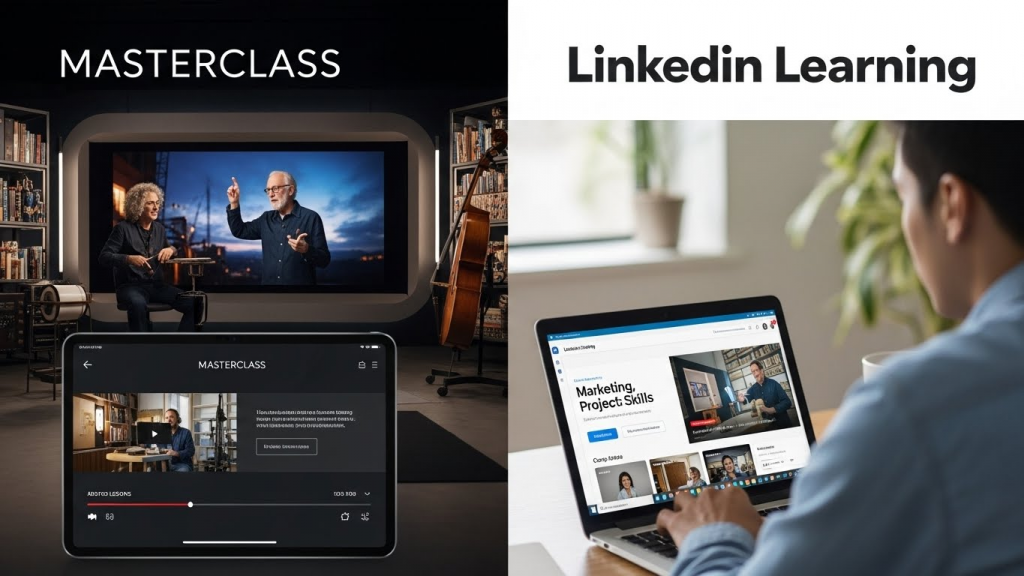
LinkedIn Learning is fully integrated with the LinkedIn professional network. It offers thousands of courses in business, technology, and creative skills and is designed to help organizations “accelerate skills and career development” with tailored learning paths.
Key strengths of LinkedIn Learning include:
- Very large catalog of short, practical courses in software, management, and creative tools.
- Certificates that you can add directly to your LinkedIn profile so recruiters can see them.
- Enterprise plans that let companies assign learning paths and track skill development across teams.
Compared with that, MasterClass feels more cinematic. You will rarely see screen recorded software demos or step by step tutorials that match a specific job description.
So LinkedIn Learning is usually better when:
- Your manager wants a specific training path, such as “Excel for finance analysts” or “New manager essentials.”
- You want badges and visible course completions on your public profile.
MasterClass makes more sense when:
- You are already comfortable in your job and want to level up your taste, creativity, presentation skills, or strategic thinking.
- You learn better from real stories than from slide decks or tool walkthroughs.
How to decide which platform fits your career goal
The question is not “Which platform is best in professional training overall”. The right question is “Which platform is best in professional training for my specific next step”.
Use these four filters.
1. What is your immediate goal?
Pick one clear statement:
- “I want to move into a new career within 6 to 12 months.”
- “I want to perform better in my current role this quarter.”
- “I want to become more creative or confident in public speaking or storytelling.”
- “I want a recognized credential to show on my CV or LinkedIn profile.”
If a formal credential or job change is at the top of your list, then Coursera or LinkedIn Learning usually wins.
If your main goal is creative confidence, better communication, or a stronger point of view, MasterClass can be a smart primary or secondary platform.
2. How structured do you want your learning to be?
Some people like strict structure. Others prefer to browse and follow curiosity.
- Coursera gives you clear syllabi, deadlines, and graded work, especially in Professional Certificates and degrees.
- LinkedIn Learning offers shorter, modular courses that you can mix and match in learning paths.
- MasterClass leans into open exploration, using playlists, categories, and recommendations instead of strict programs.
If you know you tend to drift without structure, you might pair MasterClass with a more structured program on another platform.
3. How important is measurable return on investment?
Companies that use online learning well often see higher revenue per employee, because workers can gain skills without pausing their jobs.
If you need to justify a learning budget to your boss, it is easier to point to:
- A specific Professional Certificate that matches a business need.
- A LinkedIn Learning path tied to a job family or skill gap.
MasterClass can still deliver strong ROI, but it is more indirect. It improves how you pitch, negotiate, tell stories, and make creative decisions, all of which can lift performance even if you do not receive a formal badge.
4. What type of learner are you?
Ask yourself:
- Do you remember stories more than bullet points?
- Do you enjoy watching experts “in their natural environment”?
- Do you get bored quickly with traditional lectures?
If you answer yes to these, MasterClass is likely to feel very engaging and can keep you learning consistently. If you prefer checklists, exercises, and quizzes, then Coursera or LinkedIn Learning may fit better.
How to use MasterClass as real professional training

If you decide to try MasterClass, you can treat it as a serious professional training tool rather than only as entertainment.
Here is a simple five step plan.
Step 1: Choose one competency to improve
Pick a single theme that ties several classes together, such as:
- Leadership and communication
- Storytelling and presentation skills
- Creativity and innovation for product or marketing work
This helps you avoid jumping randomly between cooking, filmmaking, and sports, which may be fun but less useful for your career.
Step 2: Build a mini curriculum
Within MasterClass, create a list of 3 to 5 classes that support the same competency.
For example:
- A leadership class from a well known CEO.
- A negotiation or communication class.
- A storytelling class from a writer or filmmaker.
Plan to watch one or two lessons per day, and schedule them in your calendar like meetings.
Step 3: Take notes and translate stories into frameworks
While you watch, keep a notebook or digital document open. Whenever an instructor shares a story, write down:
- The situation.
- The decision.
- The lesson in one sentence.
Then turn that lesson into a repeatable rule you can use at work. For example, a story about giving feedback can become a simple three step script for your next one on one.
Step 4: Apply one idea every week at work
Professional training does not count until it changes your behavior. Choose one idea each week and apply it in a meeting, email, presentation, or project.
Example:
- Use a storytelling structure from a MasterClass writer to open your next client presentation.
- Apply a negotiation tactic from a business leader when you talk about scope or fees.
Track what happens so you can see the link between learning time and business results.
Step 5: Combine MasterClass with more formal learning
For many professionals, the best setup is a hybrid:
- Use Coursera or LinkedIn Learning for hard skills such as data analysis, programming, or specific software.
- Use MasterClass to sharpen soft skills, creativity, and leadership mindset.
Together, they form a powerful professional training stack.
People also ask: common questions about MasterClass as professional training

Is MasterClass good for career growth?
Yes, MasterClass can support career growth, especially in roles where creativity, communication, storytelling, or leadership matter. You learn directly from top performers whose insights often do not appear in standard textbooks or corporate trainings.
However, if you need a specific technical skill or formal credential, you will probably need to combine MasterClass with a more traditional course.
Does MasterClass give certificates that employers respect?
MasterClass does not provide university backed degrees or widely recognized industry certificates. It focuses on learning through exposure to expert thinking rather than through formal accreditation.

For roles where certificates carry weight such as data analytics, IT, or project management, Coursera and LinkedIn Learning offer more widely accepted proof of completion.
Can companies use MasterClass for teams?
MasterClass offers plans that can be attractive as part of a broader learning and development mix, especially for leadership inspiration and culture.
Many companies still rely on platforms designed specifically for corporate training, such as LinkedIn Learning or enterprise focused plans on Coursera, because they provide dashboards, reporting, and job aligned curricula.
Is MasterClass enough on its own?
For some creative professionals, MasterClass may be enough, because the work is highly personal and portfolio driven. For most careers, the best path is to treat MasterClass as one part of your professional training toolkit.
Think of it this way:
- MasterClass shapes how you think and present yourself.
- Other platforms and real world projects prove what you can do.
Conclusion: Is MasterClass the best in professional training for you?
The global shift to online learning is here to stay, and platforms are racing to meet the demand.
MasterClass stands out by giving you rare access to world class experts and powerful stories that change how you see your work and your potential.
Coursera and LinkedIn Learning stand out by giving you structured paths, assessments, and credentials that map more directly to job descriptions.
So the real answer to “MasterClass, the best in professional training” is personal:
- If you need formal skills and credentials, start with Coursera or LinkedIn Learning and add MasterClass for inspiration and soft skills.
- If you already have a strong technical base and want to think and communicate like a top performer, MasterClass can be one of the most engaging platforms you will use.
Your next step is simple:
- Write down one clear career goal for the next year.
- Choose the platform or mix of platforms that best fits that goal.
- Commit to a realistic learning schedule and track one concrete behavior change every week.
That combination of clarity, strategy, and consistent practice is what turns any platform into the best professional training for you.
The responses below are not provided, commissioned, reviewed, approved, or otherwise endorsed by any financial entity or advertiser. It is not the advertiser’s responsibility to ensure all posts and/or questions are answered.