

Clean indoor air sounds like a comfort upgrade, but it is also a home maintenance decision that can affect energy use, HVAC wear, and how much dust and pollen your family breathes.

In the U.S., space heating and air conditioning make up 52% of household energy use on average. Even small efficiency losses can add up when your system runs for months at a time.
A basic, often overlooked step is keeping filters clean. The U.S. Department of Energy notes that routinely replacing or cleaning air filters can lower an air conditioner’s energy consumption by 5% to 15%.
So why do so many shoppers gravitate toward a direct-to-door brand like Filterbuy, and how does it stack up against two well-known alternatives?



This guide breaks it down in plain English, with a practical buying checklist at the end.
What people really want from an HVAC filter

Most homeowners are not chasing a “perfect” filter. They want a filter that does five things reliably.
1) Fits correctly (no gaps, no forcing)
A filter that is close enough can still leak air around the edges, which means less filtration and more dust getting into the system.
2) Matches the right performance level for the home
The EPA explains that MERV is a rating that reports a filter’s ability to capture particles between 0.3 and 10 microns.
Higher is not automatically better if your system cannot handle it.
3) Does not choke airflow
ASHRAE notes that increasing filter efficiency can increase pressure drop, which can reduce airflow, increase fan energy use, or both.
4) Is easy to buy again
A “good” filter you forget to replace turns into a bad filter.
ENERGY STAR recommends checking your filter monthly during heavy-use months, changing it if it looks dirty after a month, and changing it at least every 3 months.
5) Feels like fair value
Price matters, but so do shipping, waste, reorder friction, and whether you end up with a pile of wrong sizes in a closet.
Why 1 million+ customers choose Filterbuy

Filterbuy uses the line “Why 1 million+ customers choose Filterbuy” prominently in its marketing. You should treat that as a company claim, not an independently audited public figure.
Still, when you look at how the product is positioned and what the purchase experience emphasizes, the appeal is easy to understand.
A) Simple shopping, lots of sizes, less guessing
Filterbuy highlights “every single filter size, guaranteed” messaging on its site experience.
On a typical product page, you can see the “actual size” called out clearly
That is a big deal for homeowners with “weird” returns like 21.5x26x4 or other sizes that are annoying to find in-store.
B) Clear performance tiers (MERV 8, 11, 13) with plain-language use cases
On a Filterbuy product page, the brand frames MERV choices like this:
- MERV 8 for standard residential use
- MERV 11 for “healthy families” and allergy concerns
- MERV 13 positioned as “optimal” and “hospital grade” (their wording)
It also shows “comparable ratings” across other systems (MPR and FPR) and lists capture percentages for those tiers. Even if you do not memorize ratings, shoppers like seeing a decision path that feels concrete.
C) Convenience features that reduce “I forgot”
Filterbuy pages commonly push two convenience ideas:
- Filters designed to last up to 90 days (a “set it and forget it” cadence for many households).
- Auto delivery (subscription-style replenishment) shown right next to one-time purchase pricing.
This fits how many people actually behave: they do not want to research filters every time.
D) Made in the USA, positioned as a direct-from-manufacturer product
On a Filterbuy product page, the company says filters are made in the USA, and that they use 100% American-made components.
It also frames “buying directly from the manufacturer” as a value lever.
If “made in USA” matters to you, that is a clear differentiator in a category where sourcing can vary.
E) Fast fulfillment is part of the pitch
Many Filterbuy product pages explicitly state “Ships in 24 hours.”
That matters most when you realize your filter is overdue and you do not want a store run.
F) Filter replacement guidance baked into the shopping page
Instead of sending you to a separate blog post, Filterbuy includes replacement timing tips directly on product pages, such as:
- Replace every 90 days generally
- Every 6 weeks for asthma or allergies (their guidance)
- Every 2 months with pets (their guidance)
You can compare that to ENERGY STAR’s more general “check monthly, change at least every 3 months” guidance.
A quick, practical comparison: Filterbuy vs Filtrete vs Nordic Pure
Below is a high-level comparison based on what each brand emphasizes publicly.
| Feature | Filterbuy | Filtrete (3M) | Nordic Pure |
|---|---|---|---|
| Core model | Direct-to-consumer, many sizes, reorder options | Major retail presence plus brand site | Direct-to-consumer plus bulk/custom |
| Rating language | MERV tiers and “help me choose” framing | Uses MPR and discusses how it relates to MERV | MERV-focused with education and product lines |
| “Smart” features | Subscription style auto-delivery on product pages | “Smart Air Filters” and reminder-style products | Subscribe & Save and reminders |
| Waste reduction angle | Not a primary headline on product pages | Refillable filter kit positioned as less waste | Mentions eco-friendly product lines (site FAQ area) |
| Made in USA messaging | Explicit on product pages | Varies by product and not consistently highlighted on the page types above | Notes “freshly manufactured filters straight from our U.S. facility” |
What this table really means
- If you want maximum size availability with a direct reorder flow, Filterbuy and Nordic Pure are naturally strong.
- If you want a widely known brand with alternate rating language (MPR) and add-ons like smart filters or refillable frames, Filtrete is built around that positioning.
- If you want custom sizes and a “buy direct from a U.S. facility” message, Nordic Pure leans into that.
How to choose the right filter without overthinking it

The “best” filter is the one that fits, supports airflow, and matches what you are trying to protect: your HVAC equipment, your indoor air, or both.
Step 1: Confirm size (nominal vs actual)
Most frames show a nominal size (like 20x25x1), but actual dimensions can be slightly smaller. Filterbuy product pages call out “actual size,” which is the number that matters for fit.
Step 2: Pick a MERV range based on goals
The EPA’s MERV overview is a good baseline for understanding what the rating measures.
A simple way to think about it:
- MERV 8: Often a solid baseline for capturing larger household particles in many systems.
- MERV 11: A common step-up for homes with pets, higher dust, or allergy concerns.
- MERV 13: Higher efficiency, often chosen for stronger particle capture, but you should confirm your system can handle it.
ASHRAE has recommended MERV 13 in certain contexts, while also emphasizing that system capability and pressure drop matter.
Step 3: Match replacement frequency to your home’s reality
Use a blend of authoritative guidance plus your conditions.
- ENERGY STAR: check monthly during heavy-use months, change if dirty after a month, change at least every 3 months.
- Filterbuy’s on-page guidance: every 90 days generally, more often for allergies or pets.
If you want the easy version: set a recurring reminder or use auto-delivery.
Step 4: Remember why this matters for energy
Heating and cooling are a huge part of household energy use.
And DOE’s guidance on filter maintenance and AC energy use is straightforward: keeping filters clean can reduce energy consumption by 5% to 15% for air conditioning.
People Also Asked style questions

Is Filterbuy a good choice if I have an odd filter size?
It can be, because the brand heavily emphasizes size availability and shows actual dimensions on product pages.
If you have a true custom need, Nordic Pure also explicitly offers custom sizing.
Are higher MERV filters always better?
Not always.
They can capture more particles, but ASHRAE notes higher efficiency can increase pressure drop and affect airflow or energy use.
If you want to upgrade, it is smart to confirm what your HVAC system can accommodate.
What is the difference between MERV and Filtrete’s MPR?
MERV is an industry standard rating.
Filtrete’s MPR is a proprietary rating that Filtrete describes as focusing on capturing smaller microparticles and comparing how MPR relates to MERV.
How often should I change my air filter, really?
A reasonable baseline is ENERGY STAR’s “check monthly, change at least every 3 months,” with more frequent changes if the filter looks dirty sooner.
Some brands provide more specific guidance based on pets or allergies on their product pages.
A simple “best fit” guide for choosing among the three brands
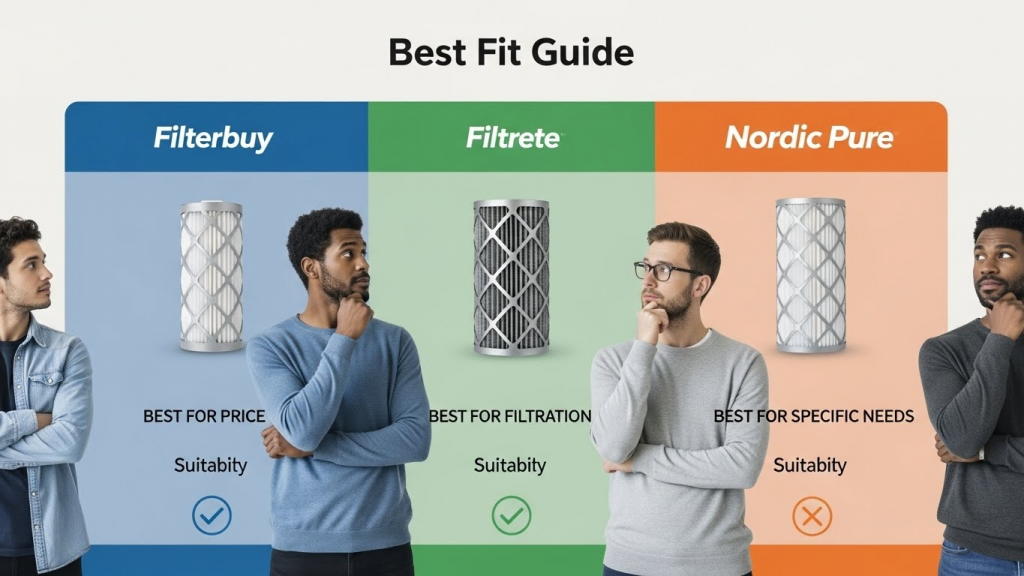
Choose Filterbuy if you want
- A direct-to-door reorder flow with performance tiers and clear sizing.
- Made in USA messaging and a quick-ship promise on many product pages.
- Auto-delivery shown right next to the product purchase flow.
Choose Filtrete if you want
- A widely distributed brand with education around MPR vs MERV.
- Smart filter options or a refillable kit positioned as lower waste.
Choose Nordic Pure if you want
- A “buy direct” approach with U.S. facility language plus custom sizes.
- Subscription or reminders to stay on schedule.
Conclusion: The real reason this decision matters
When heating and cooling account for over half of home energy use on average, HVAC efficiency is not a tiny detail.
Filter maintenance is one of the simplest levers you control. DOE explicitly ties clean filters to meaningful AC energy savings.
So, why 1 million+ customers choose Filterbuy, at least as the brand frames it, comes down to a few practical wins: broad sizing, simple MERV tiering, fast shipping promises, made-in-USA positioning, and built-in reorder options.
If you take one action after reading this, do this: check your filter today, and set a replacement plan you will actually follow.
The responses below are not provided, commissioned, reviewed, approved, or otherwise endorsed by any financial entity or advertiser. It is not the advertiser’s responsibility to ensure all posts and/or questions are answered.